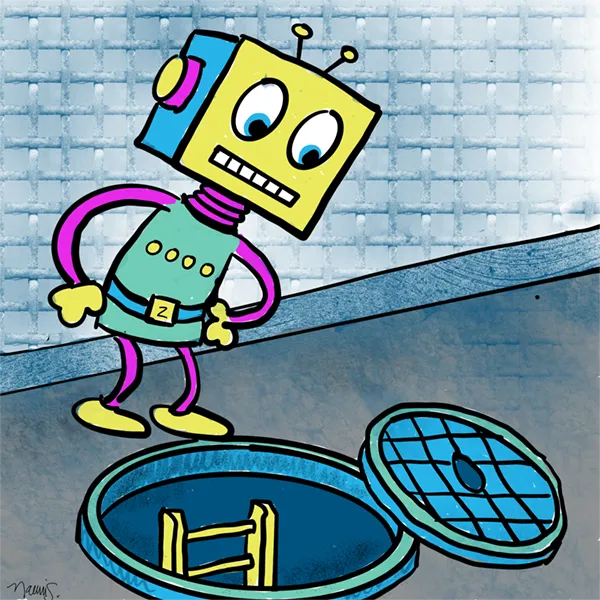
LinkedIn has been a cesspool of humble-bragging and recycled ideas pretty much since it was launched (or perhaps ‘dug.’) With the widespread use of A.I., it’s decayed further into a stinky swamp of AI-generated ‘content.’ (In fact, maybe we should call this stuff ‘discontent.’)
It seems that AI said to itself “Self? People don’t like long paragraphs. Great! I’ll write short choppy sentences, each one its own paragraph. OK, next, where’s a punctuation mark I can overuse—yes, the em-dash! I’ll adopt this as my little hobo sign, ruining it for everyone else—Emily Dickinson be damned! And how about making things more interesting with controversy? Awesome! I’ll write a lot of It’s not just this … it’s this other thing! Last but not least, let’s find some great adverbs. Some … QUIET adverbs. Now everything will fail silently!”
Why are we reading so much of this drek? My friends* say that volume and consistency will make more people comment on your posts. This makes LinkedIn decide your posts are interesting and show them to more people, who presumably will then comment (especially if they’re your vendors!) If you’re trying to build an audience for whatever reason, this is a great idea. (*By “my friends,” I mean “people whose advice I respect.” If you told Jay Schwedelson I was his “friend,” he’d say “Who?”)
But who’s got time to write a weekly LinkedIn post? Zorgon, that’s who! Yep, with a shiny $20/month AI account, you can “write” a lot of LinkedIn posts. But should you?
Keeping your slop less sloppy Here are a few tips to keep it real, even if you are outsourcing the writing to an A.I.
- Don’t post unless you’ve got something to say. And by “you,” I mean the beautiful bag of water that is reading this post right now, not your A.I. tool or even (gasp!) your marketing department. Steer clear of topics that are stupid, even if you think they will get people commenting. No one cares about “Email is dead,” “Cold calling is dead,” “A.I. is the be-all and blah-all.” Sure, people might comment on your posts, but they won’t care or remember you later on.
- Make sure you get rid of obvious A.I. “tells.” Super pro tip: if you copy-paste from ChatGPT to LinkedIn, your post is going to appear in a DIFFERENT FONT than the rest of LinkedIn and it’s going to be glaringly obvious who wrote it. A former employer of mine keeps doing this and it makes me want to curl up into a tiny ball of cringe.
- Before posting, check your material carefully. You still need to count fingers and toes on people and make sure that illustrations are accurate. If the A.I. has cited ‘facts,’ ask it for the source and look it up yourself. Read what it’s written and see if it actually makes sense to you. It’s easy to be lulled by copy that sounds smart but is actually just a pile of whatever.
- If you’re scheduling posts to run at a later time, keep an eye on the news cycle and make sure you alter your posts if something happens that would make them irrelevant. I was in Paris getting ready for a trade show in November 2015 when terrorists attacked the Bataclan music hall. While hunkered down in my hotel room with 9 kg of Finnish chocolate, I had to remember to change all the happy-sounding posts I’d queued up to “visit us in Paris at the trade show!” (The show did go on, but our posts were quite a bit more sober than originally planned).
Don’t be a pompous ass This last suggestion has very little to do with A.I. and everything to do with not being a pompous ass. In your daily life, a lot of stuff happens. You get stuck in traffic, your pet lemur does something cute, the mail carrier remembers your name. Not everything has to translate into a business epiphany. If you decided to try oat milk in your cappuccino, congratulations and yummy. Your ‘friends’ on LinkedIn don’t need to hear what Eleanor Roosevelt said about conquering fear. Don’t be a pompous ass.